Passive vs Active Fire Protection: What Every Building Manager Should Know
When it comes to fire protection, many assume the responsibility lies solely with alarms and sprinklers. But true fire safety is built into the bones of a building, and it depends on a strategic balance between active and passive fire systems.
Understanding the difference is critical. Because overlooking one or the other doesn’t just compromise safety, it creates risks for compliance, handover, and long-term operation.
Here’s a simple breakdown of both systems, where each applies, and why the most effective fire strategies use both in tandem.
Passive Fire Protection: Always On, Always Working
Passive fire protection is built into the structure itself. It’s not something that needs to activate, it’s always there, working to contain fire and smoke, preserve escape routes, and maintain the building’s structural integrity.
At Sentinel, our passive fire protection work spans:
- Fire stopping around service penetrations
- Intumescent coatings and spray-applied steel protection
- Fire-rated boards, ceilings, barriers and curtains
- Full builder’s work in connection (BWIC)
- Air sealing to prevent smoke spread
These systems are fundamental. They ensure that even if a fire breaks out, it’s slowed, contained, and structurally managed long enough for evacuation and emergency response.
Active Fire Protection: Alert, Respond, Suppress
Active fire protection refers to systems that respond to a fire, typically through sensors or manual intervention. These are the systems most people associate with fire safety:
- Smoke and heat detectors
- Sprinkler and suppression systems
- Smoke control and ventilation
- Emergency alarms and comms
They’re vital. But they can only do so much. And they rely on power, maintenance, and flawless activation.
The Risk of Prioritising One Over the Other
A complete strategy uses both. Because if one layer fails, the other must hold.
We’ve seen it happen, overinvestment in active systems, while passive protection is under-specified, poorly installed, or left until too late in the programme.
The result? Gaps in compartmentation. Unsealed service penetrations. Non-compliance at handover.
The safest, most efficient buildings take a joined-up approach. One that layers passive protection into the very structure of the build, supported by active systems designed to alert and suppress.
Real-World Protection, Designed to Perform
Passive fire protection isn’t just a checklist, it’s a critical component of structural safety, especially under today’s regulatory environment and the Golden Thread
That’s why we don’t treat it as an afterthought. Sentinel provides:
- End-to-end fire protection system design
- Intumescent coatings and board protection
- Full fire stopping services across London and the UK
- Traceable documentation using the Onetrace system
- IFC-certified install teams
- Seamless coordination with BWIC and MEP trades
Our work supports compliance with the Building Safety Act, the Golden Thread, and the Fire Safety (England) Regulations 2022, giving clients confidence that what’s built in is built to last.
On a recent refurbishment project involving exposed steel beams, our team applied an intumescent paint system to protect the structural frame in the event of fire.
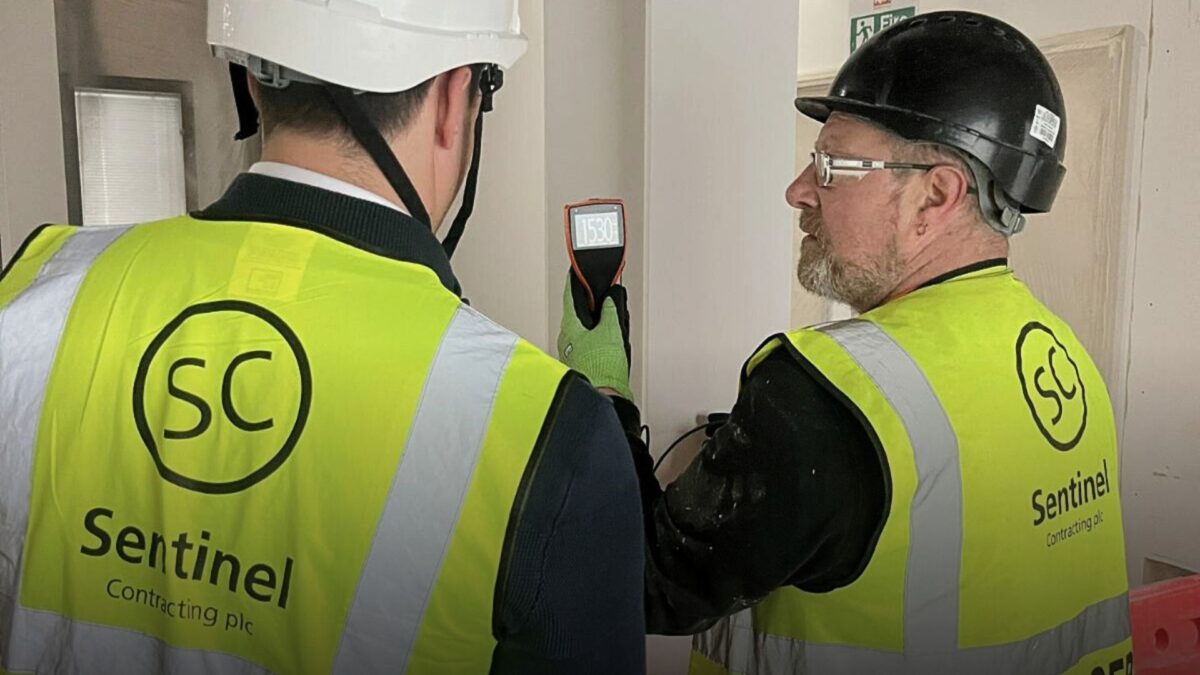
Using elcometer gauges, we measured the dry film thickness (DFT) at every stage, ensuring the primer layer reached 75–150 microns and the intumescent coating built up to 1,200 microns or more, as required by the specification.
Across the project, over 18,000 readings were taken per floor, giving the client complete assurance that every beam met performance requirements, with documentation to prove it.
This is what real-world fire protection looks like: precise, accountable, and built to perform.
What to Look for in a Fire Protection Partner
Fire safety doesn’t end at install. It lives on in the documentation, the maintenance, and the integrity of every seal.
The right fire protection contractor should:
- Understand your building’s specific fire strategy
- Support coordination between trades and sequencing
- Be certified, compliant, and up to date with the latest guidance
- Offer full passive solutions, not just patchwork fixes
As trusted fire protection contractors in the UK, we’re known for supporting projects where quality, traceability, and accountability matter.
If you’re planning, managing, or retrofitting a building and want passive fire protection scoped and installed properly, we’re here to help.
Explore our full range of fire stopping services in London, or get in touch with the Sentinel team to start a conversation.
Let’s make your building safer, from the inside out.

Decorating Occupied Hospitals and Healthcare Buildings: Infection Control Meets Programme Certainty

Redecorating a live hospital ward is nothing like redecorating an empty office floor. The patients do not leave. The clinical routines do not pause. Infection control procedures do not relax because a contractor needs to apply a second coat.

When was your building last Fire Inspected?
Fire protection can be installed correctly at construction yet still need attention later, as buildings change, services are added, refurbishments occur, and new penetrations appear behind ceilings and finishes.